In a fog of uncertainty, Canada plays to its strengths
It wasn’t long ago that governments viewed competitiveness primarily through the lens of productivity and GDP growth. But intensifying geopolitics, a technological upheaval, and tensions in Europe and the Middle East disrupting supply chains and reshaping global commerce is shifting that definition. Today, competitiveness is increasingly understood as a nation’s capacity to shape its own outcomes in an uncertain world.
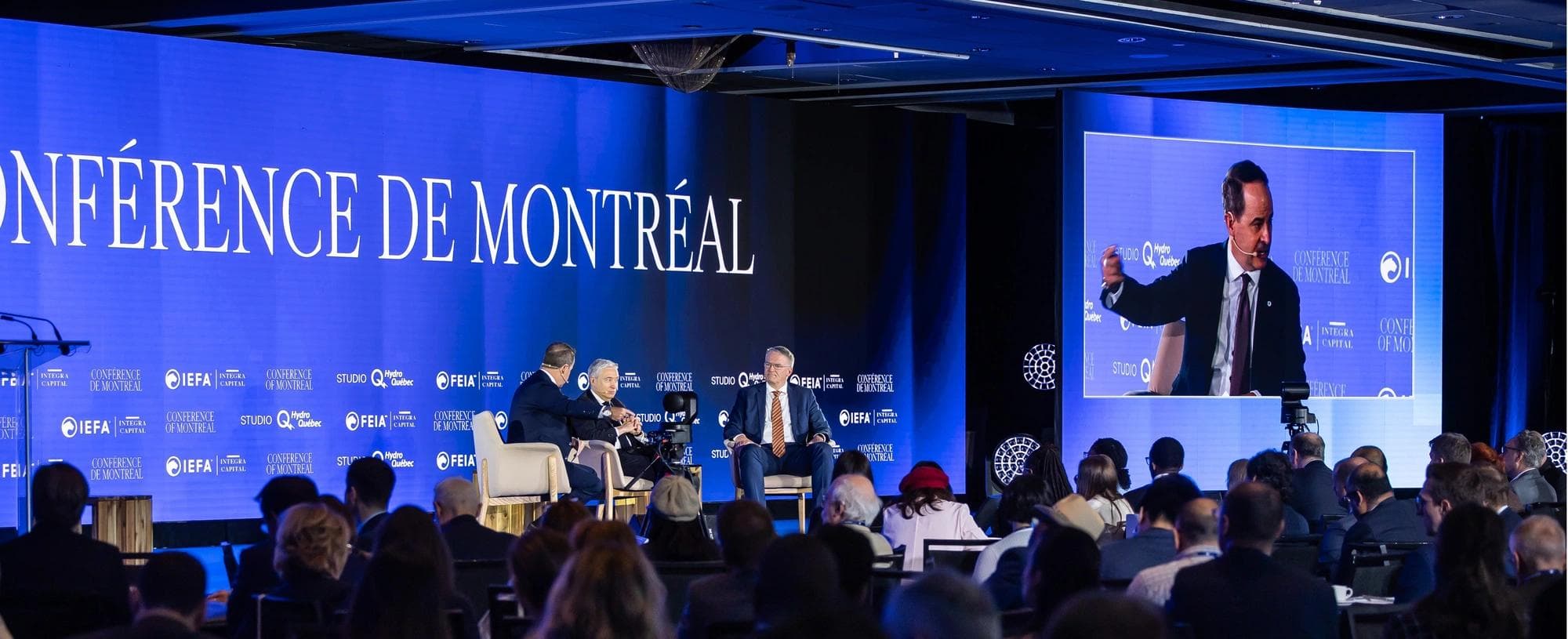
How does Canada fit into this new dynamic as a middle power? That was the focus of The new policy playbook for competitiveness panel at the International Economic Forum of the Americas’ (IEFA) 32nd Conférence de Montréal that featured:

Darryl White, Chief Executive Officer of BMO Financial Group (moderator)
François-Philippe Champagne, -Minister of Finance and National Revenue, Canada Development
Mathias Cormann, Secretary-General of the Organisation for Economic Co-operation and Development (OECD) and Australia’s former Finance Minister
Listen to the conversation:
Markets Plus is live on all major channels, including Apple and Spotify.
Here are some key takeaways:
Unlocking productivity
There are significant productivity growth challenges across OECD member economies due to emerging risks. Those headwinds range from climate change to geopolitics, the latter of which is affecting supply chains and leading to uneven trade practices, said Mathias Cormann. Rules around open markets are also under increasing pressure, he added, pointing to the concentration of critical minerals supply among a small group of countries as an example.
International trading arrangements need to function better and more fairly than they currently do, Cormann noted. “What we say to member governments and countries around the world is, ‘Work harder to resolve those issues through dialogue and cooperation,’” he said. “Avoid doing it unilaterally because unilateral measures inevitably make things worse.”
As for Canada, the country is approaching the current moment from a position of comparative strength, with the OECD projecting the second-fastest growth outlook among the G7, behind only the United States. “Systems that are based on market economic principles and democracy are agile enough to adjust and respond,” he said. “I think that is a sustained ingredient of success for countries like Canada.”
An energy superpower
Canada’s strategy is to build on its strengths, said François-Philippe Champagne. As a middle power, it can’t outspend larger economies, but it can lean into areas where it already holds an advantage. That includes energy, critical resources, infrastructure and market access, while developing new nation-building tools. One of those new tools is the Canada Strong Fund, the country’s first sovereign wealth fund aimed at attracting private investment.
Underlying that strategy is a growing link between food, energy, economic and national security. That connectivity, Champagne noted, has never been greater as countries rethink supply chains and long-term energy security.
He highlighted Canada’s access to three oceans, large reserves of LNG, oil and gas, growing renewable energy capacity and an advantage in nuclear power. Canada, he noted, is set to become the first G7 country to bring a small modular reactor into operation. “When we say we’re going to be an energy superpower, this is not just a slogan,” he said. “It’s really a need in the world where the architecture is being redesigned.”
Champagne pointed to a recent commitment by Shell to invest C$22 billion in Western Canada as a sign the strategy is working, adding the government’s role is to reduce risk and create the conditions that attract more investment.
Positioning for the long term
Despite the global headwinds, the fundamentals of economic success remain consistent, said Cormann. Countries best positioned to compete over time tend to share the same foundations – open and competitive markets, predictable rules of governance, a skilled workforce, strong infrastructure and institutions that maintain the trust of citizens and investors.
Cormann views AI as a key component of the long-term outlook, but only if its adoption extends broadly across economies and reaches beyond the largest firms. Ultimately, the benefits of AI will hinge not just on innovation itself, but on how widely it is disseminated.
To broaden access to the gains the technology could provide, countries will need the right infrastructure, skills and policy settings in place so businesses and workers can participate. Reliable and affordable energy, digital infrastructure and regulation that supports adoption without undermining public trust all matter, he added.
Under the right conditions, Cormann said AI has the potential to add up to 1.3% to annual productivity growth. While that may sound modest in a single year, he noted that the gains compound over time. “The upside opportunity is unbelievably exciting,” he said.
Be a lighthouse in a sea of uncertainty
Of course, as resilient as Canada has been, no country is immune from the changes happening in the world. The biggest threat for Champagne? Affordability. “The issue of affordability is front and center for all countries,” said Champagne. “We’re moving from an energy crisis to an affordability issue.”
Much of that has to do with the conflict in the Middle East. The OECD’s latest Economic Outlook examined how conflict is having significant humanitarian costs while testing global economic resilience through chokepoints such as the Strait of Hormuz. The longer disruptions persist, the greater the risk that higher energy costs spill into food, fertilizers and materials needed across global supply chains, explained Cormann. “The punchline across the board is lower growth, higher inflation,” he said.
Picking up on that point, Champagne pointed to how quickly global shocks now move through economies. He recalled warning counterparts during Canada’s 2025 G7 presidency that “we cannot let uncertainty become the new certainty.” Today’s reality demands a different kind of leadership, he noted. “We need to be the lighthouses in this fog of uncertainty.”