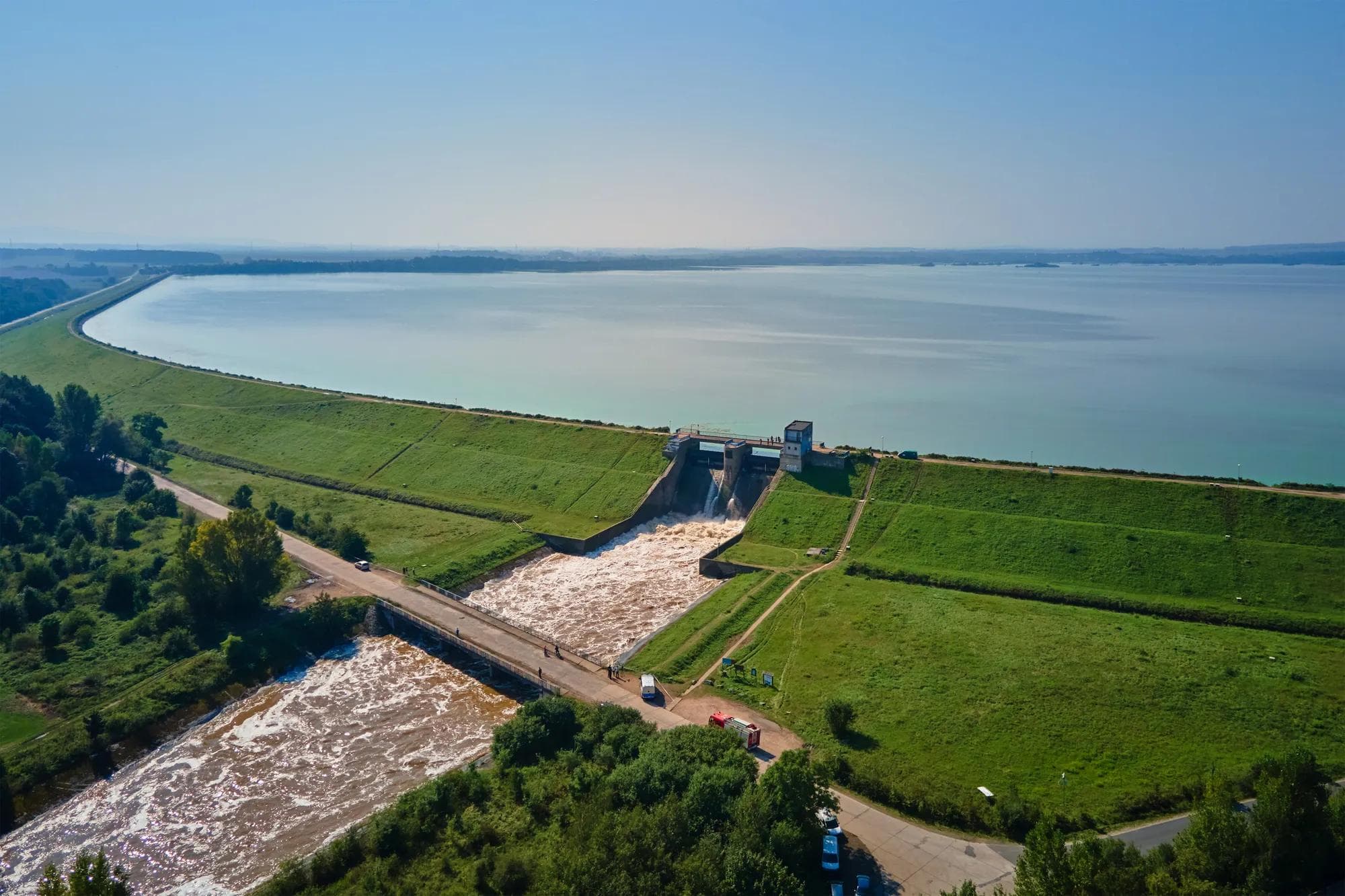
A little more than 70% of the Earth’s surface is covered by water, but less than 1% of it is considered usable. That precious supply is under mounting stress from environmental pressures and growing demand, a challenge that’s compounded by aging infrastructure and resource mismanagement.
These risks are already impacting economies around the world, including in the continental U.S. A BMO Climate Institute analysis showed that a 2030 drought could cost California US$1.4 billion and affect a variety of industries, including agriculture, manufacturing, technology and other sectors that depend on reliable water access. The report finds that in the U.S. alone, an estimated US$1 trillion will be needed over the next 25 years to modernize water infrastructure.
Fortunately, solutions to the water challenge are emerging, with some presenting compelling investment opportunities. To explore this critical issue, I moderated a panel discussion entitled, “The Future of Water: Challenges, Innovation and Investment,” organized by the Financial Women’s Association. The panel examined how innovation, policy, and capital are converging to shape the future of water.
Joining me on the panel were:

Hedy Gutfreund, Principal, Global Impact, KKR
Aleem Remtula, Managing Director and Head of Private Equity and Infrastructure, WaterEquity
Marc Robert, Chief Operating Officer, Water Asset Management
Investing in solutions
Some of the challenges facing businesses in the U.S. West reflect how regulation and policy can lead to unintended consequences. As noted by Marc Robert of Water Asset Management, the legal system in the Western U.S. incentivizes farmers with access to water to use it all or risk potential forfeiture. That’s led to certain cases of farmers using $1,000 of water to grow $200 worth of crops, he explained.
This is a solvable problem that can be positively influenced by investment, he said. “We have a well-intentioned agricultural community that in different parts of the West are growing very thirsty, low-value crops,” he said. “Our entire investment strategy is working with farmers to change that practice, creating incentives to move to higher productivity, lower water-consuming crops, thus enabling greater water supplies for the community.”
The solution could be as simple as shifting some of those crops to those that require less water and getting consumers to consider how they use water effectively. “We believe that transparency around the real value of water actually is the best way to make sure that people don’t waste it,” he said.
As much as there are technological solutions, simply changing behavior and habits can help alleviate the strain on the water system. For instance, Robert noted that some of the cropland in question is being used to produce hay for export to Asia and the Middle East to support the domestic dairy industry.
“It would take very little change to shift some of that growth into other crops, or more variable use of those crops to create quite a supply of water that could be used for the West,” he said. “So, we’re quite optimistic.”
Water and the AI revolution
The importance of water to the global economy can’t be overstated. Aleem Remtula of WaterEquity said roughly 60% of global GDP relies on water in some way. That dependence includes the rapid expansion of AI, as many of the data centers that are the backbone of that technology use water to cool their servers.
Right now, there’s a significant disconnect between the scale of investment in AI and water, he explains. “We’re collectively putting in hundreds of billions of dollars of investment into water-dependent sectors, but only hundreds of millions of dollars into water infrastructure that will supply that,” he said.
Mid-market private equity and the water challenge
Hedy Gutfreund of KKR noted that whether it’s investing in water challenges within wastewater and water quality or reducing water usage in areas like data centers, water is clearly capturing the attention of investors and noted the influx of interest she’s seen in the space. Still, investors want to be rewarded for the risk they’re assuming. “Capital goes where it’s best treated,” noted Robert.
From the mid-market private equity perspective, firms like KKR – specifically through KKR’s Global Impact strategy – are looking for opportunities to scale high-quality businesses that are solving big global challenges.
Specifically, KKR has invested against the nutrient pollution theme. This sort of pollution can lead to toxic water that is unusable for drinking, irrigation, or recreation. “It’s a massive issue with about 44% of rivers and streams, 50% of lake acres, 17% of coastal waters, and 23% of Great Lakes nearshore waters having excess nutrients, which can cause water quality issues,” Gutfreund said.
To address this issue, KKR has built a platform called Axius Water that brings together leading brands in nutrient management. KKR’s Global Impact strategy invested in Axius alongside XPV Water Partners and is focused on solving major water quality challenges.
KKR’s Global Impact strategy has also invested in CoolIT Systems, a provider of data center liquid cooling. CoolIT’s proprietary technology delivers cooling fluid directly to high-powered components like CPUs and GPUs, enabling greater density in data centers and reducing water usage. Gutfreund noted that as of the end of 2024, CoolIT had already saved one billion kilowatt hours of energy for customers through CoolIT products and is saving water alongside those energy savings.
Investing realities
As much as technology continues to advance to improve access to water, affordability remains an important factor. “You can have great technology, but if it’s not accessible, and people can’t afford it, then really there’s no point,” Remtula said, which is why he emphasized looking at opportunities through an affordability and access lens.
Costly systems may still have a role, but only where the economics make sense. Communities will probably still have to diversify their water supply, including using agricultural water, desalinated water, and reused wastewater.