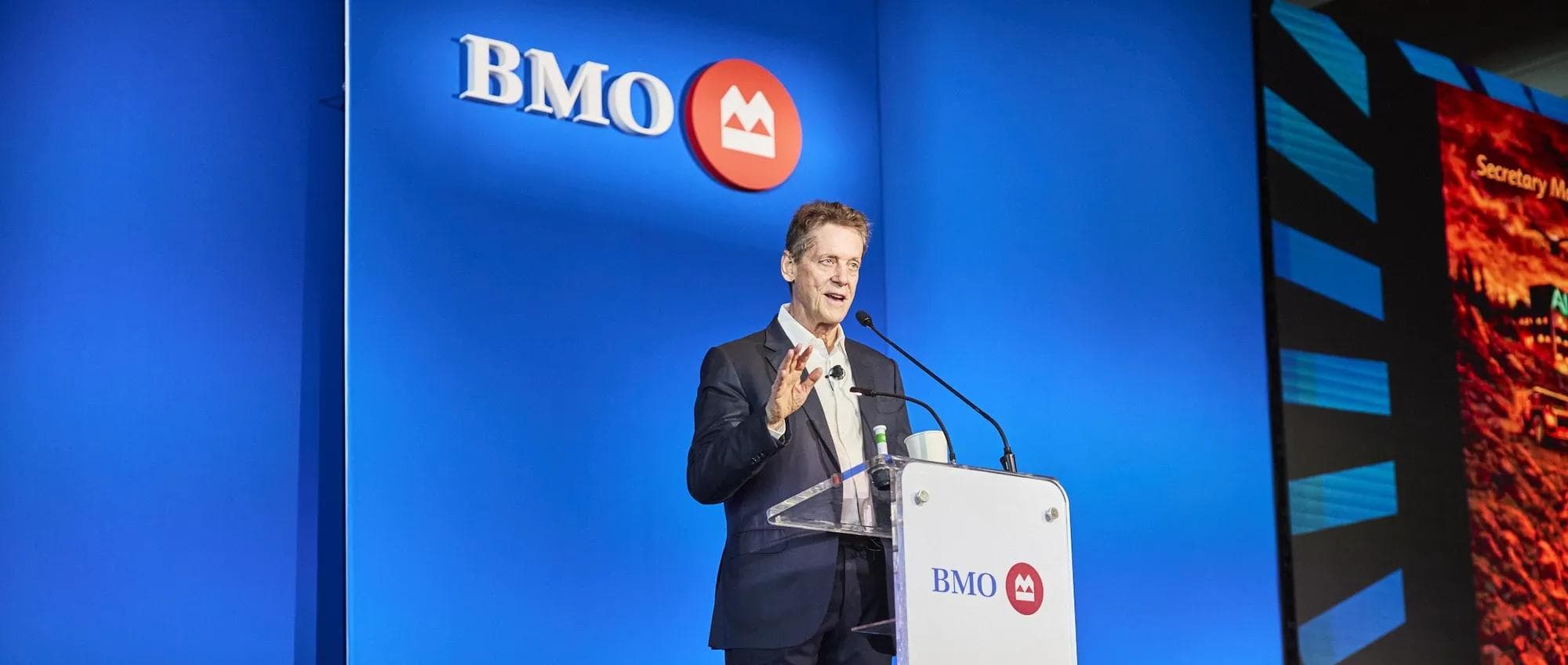
As a transformative mining entrepreneur and the driving force behind some of the world’s most significant mineral discoveries, Robert Friedland knows better than most how to navigate market cycles, identify risks and unlock opportunities.
During the “The Dawn of the Copper Age” keynote at the 35th Annual BMO Global Mining, Metals & Critical Minerals Conference, Friedland, the Founder and Executive Co-Chairman of Ivanhoe Corp., identified risks that may pose obstacles to pursuing economic opportunities on the horizon.
The rise of data centers, Artificial Intelligence, and reindustrialization has created significant demand for critical minerals and essential industrial metals like copper. Geopolitical tensions could impede the industry’s ability to meet growing demand. Combine these issues with structural problems around how mines are approved, financed and developed, and supply could be further constrained.
Here are highlights from his keynote:
The AI revolution uses copper
While the need for copper has been steadily increasing for years, the emergence of generative AI and the rapid expansion of data centers have taken demand to a new level. A 500-megawatt data center would require a lot of copper, along with a group of other rare-earth materials and critical metals such as barium, antimony, titanium, indium, silver, tungsten, gold, gallium and palladium.
When combined with defense and other needs, Friedland said the world needs to add multiple new tier-one copper mines annually to meet global demand, specifically supporting electrification, data centers and the revitalization of the grid. “The deficit is real,” he said.
To put that in context, the amount of copper required in the next 18 years to meet expected demand is equal to all the copper that’s ever been mined so far – an estimated 700 million metric tonnes, added Friedland.
Critical mineral supply chain at risk
As the industry works to determine where the global economy will source the metals and critical minerals it needs, there is growing concern that supply chains are vulnerable to geopolitical tensions and require diversification.
Today, the critical minerals supply chain is concentrated in China. “We don’t have an economy without those metals,” said Friedland. “There’s a growing global recognition that we need to have supply chains for critical minerals that are reliable and diverse across the world.”
He singled out aluminum-scandium alloy. Not only is the material a leading candidate for next-generation memory chips, but it’s also promising for the future of 6G wireless communication, defense and 3D printing. “I can’t possibly overemphasize how critical these metals are,” he said.
Adding supply chain resilience
Countries like China have gained a dominant role in the global supply chain in part because of the way they approve and support new mines. If a Chinese company wants to build a mine, they just ask the government for funding, said Friedland.
The U.S. is looking to follow suit. Friedland applauded the move earlier this year by the Export-Import Bank of the U.S. to launch Project Vault, a $12 billion plan to stockpile 60 critical minerals to provide economic security and strengthen industrial resilience during supply chain disruptions.
Adding geothermal power to the energy mix
Access to metals and critical minerals is important for another reason: power generation. In some scenarios, data centers and other technologies could use as much as 1,000 terawatt-hours of electricity by the end of this year, equal to Japan’s total consumption, said Friedland.
Power generation is another area where Friedland said developed nations are falling behind, noting that it can take up to a decade to get a new power plant online.
In Friedland’s opinion, the solution to the U.S. power problem lies in geothermal power. He explained that, while the country has more untapped geothermal resources than any other country, it generates less than 1% of its power from geothermal plants.
The U.S. faces challenges to get more power from geothermal because of the cost and difficulty of drilling into deep, hard rock at scale. Conventional mechanical drills wear out quickly, making these projects uneconomic. Another of Friedland’s companies, G-Pulse, a company of the I-Pulse Group, is developing a hybrid, pulsed-power drilling technology that combines conventional rotary drilling with very high-voltage electrical pulses to fracture hard rock, like granite, faster and cheaper.
Addressing risks to security and growth
The main takeaway from Friedland’s keynote was that a lack of metals supply and power can pose risks to modern lifestyles. Friedland reminded the audience that there are still physical constraints on the future that can’t be ignored and can’t be solved with the ease of using a 3D printer. “You can’t print mines,” he said. “You can’t print real things.”