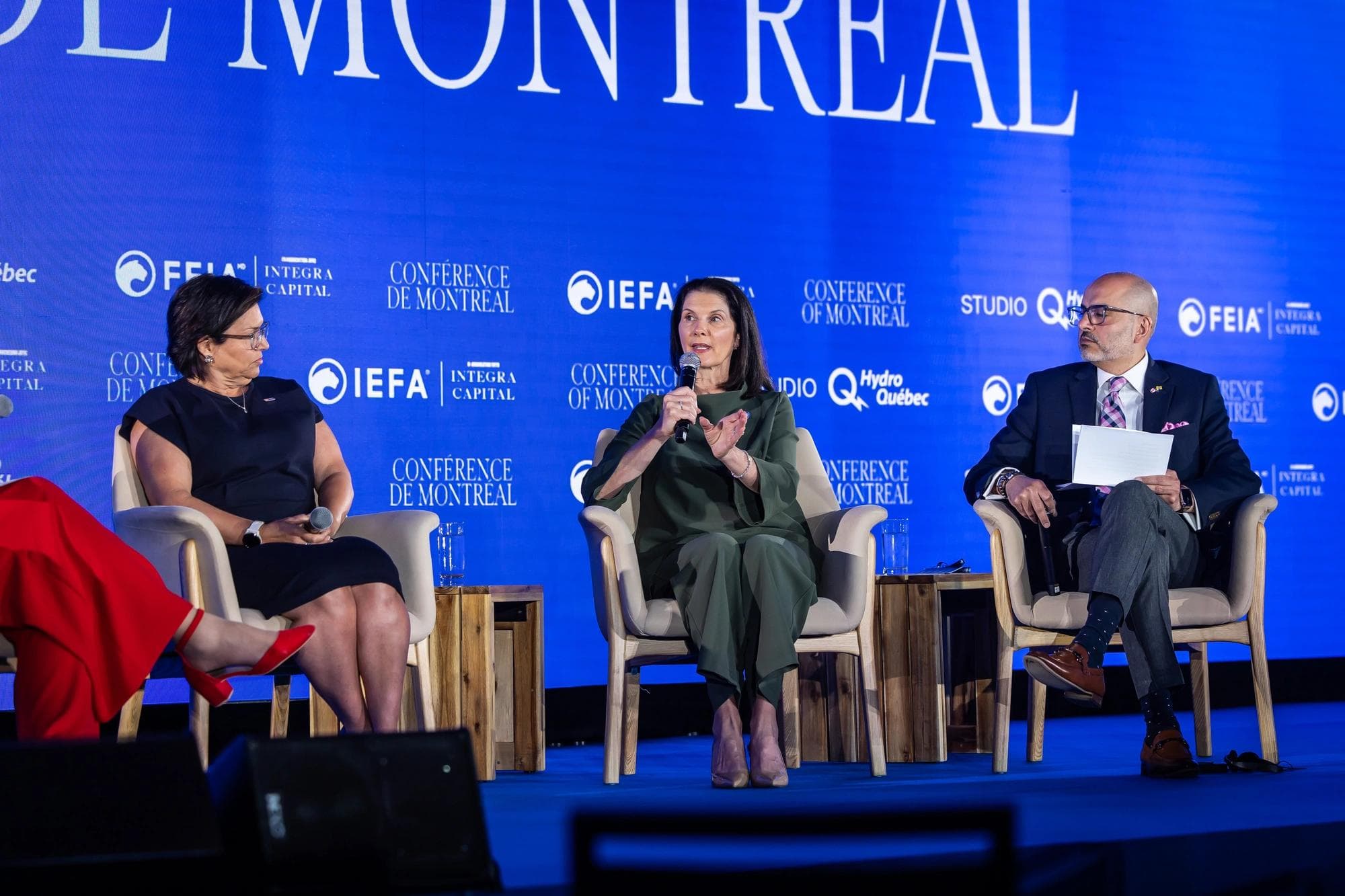
There’s no doubt that a workplace transformation is underway as the discourse around generative AI’s impact on white-collar jobs and employment continues to heat up. This month, the federal government launched its ambitious national AI strategy, making it the perfect time to facilitate a conversation on changing dynamics.
At the Conference de Montréal, Mona Malone, Chief Administrative Officer, Chief Human Resources Officer and Head of People, Culture and Brand at BMO, participated in a panel titled, “Reinventing Jobs in the Age of Technological Transformation”. The session also featured:

Geneviève Mottard, President and CEO, Ordre des CPA du Québec
Dave Chopra, Executive Vice President and Country Head Canada, HCLTech
Mélanie Roussy, Professor, School of Accounting, Laval University
Chloé Sondervorst, Producer, AI and Digital Culture, CBC/Radio Canada (Moderator)
The discussion touched on using AI strategically, ensuring employees find purpose as their roles change and keeping leadership accountable as big decisions are made.
Here are some of the highlights:
Transforming jobs
As more companies incorporate AI, panelists said technology should be there to augment, not replace employees. Geneviève Mottard drew a comparison to the introduction of calculators to the accounting profession. Despite the initial fears that accountants would be replaced, the profession ultimately embraced the new technology as a critical tool.
Malone said an approach that’s worked well at BMO has been to invest in upskilling the entire workforce and putting AI into the hands of all employees so they can begin experimenting and building comfort with new tools. It also requires a mindset shift in getting people to think of themselves as managers of digital work. This perspective encourages employees to think about accountability and empowers them to consider new ways to improve their workflow. “It’s engaging, it’s exciting; it turns on critical thinking and creativity,” she said. “Shifting people to think of themselves as managers with new suites of tools and new ways of working for us has been very helpful.”
The importance of accountability
Another theme panelists revisited was accountability in leadership. Generative AI may be useful in certain scenarios, but that doesn’t excuse organizations from using critical thinking – whether it’s in everyday decisions or significant ones.
“AI will not always make the right decision,” said Dave Chopra. “The problem is it’s actually at times very difficult to track AI’s outcome towards what the expectation was and when it becomes a grave mistake.”
The question then becomes how employees can use critical human skills, like empathy, creativity, judgment and ethics, in their jobs.
“We often think about AI and the impact on jobs, but quite honestly, it’s the impact on work and work processes, because it’s tasks that you’re doing in different ways,” explained Malone.
Value creation
For Malone, ethics needs to be top of mind as businesses think through AI’s place. As companies pursue value, ethics needs to be at the center with governance and a sense of security at the top, she explains. In her view, focusing exclusively on value and disregarding the wider impacts doesn’t serve anyone’s interests.
“If you have the point of value creation too heavy and you don’t have weight on those other factors, that’s when you get negative consequences in an organization, and in an industry and society more broadly.”