Deploying an AI strategy that delivers measurable business value can accelerate both growth and efficiency across industries. Despite the enthusiasm, recent surveys suggest many CEOs have yet to realize a return on their investments in the technology. What’s causing the gap? Are organizations viewing ROI through the wrong lens?
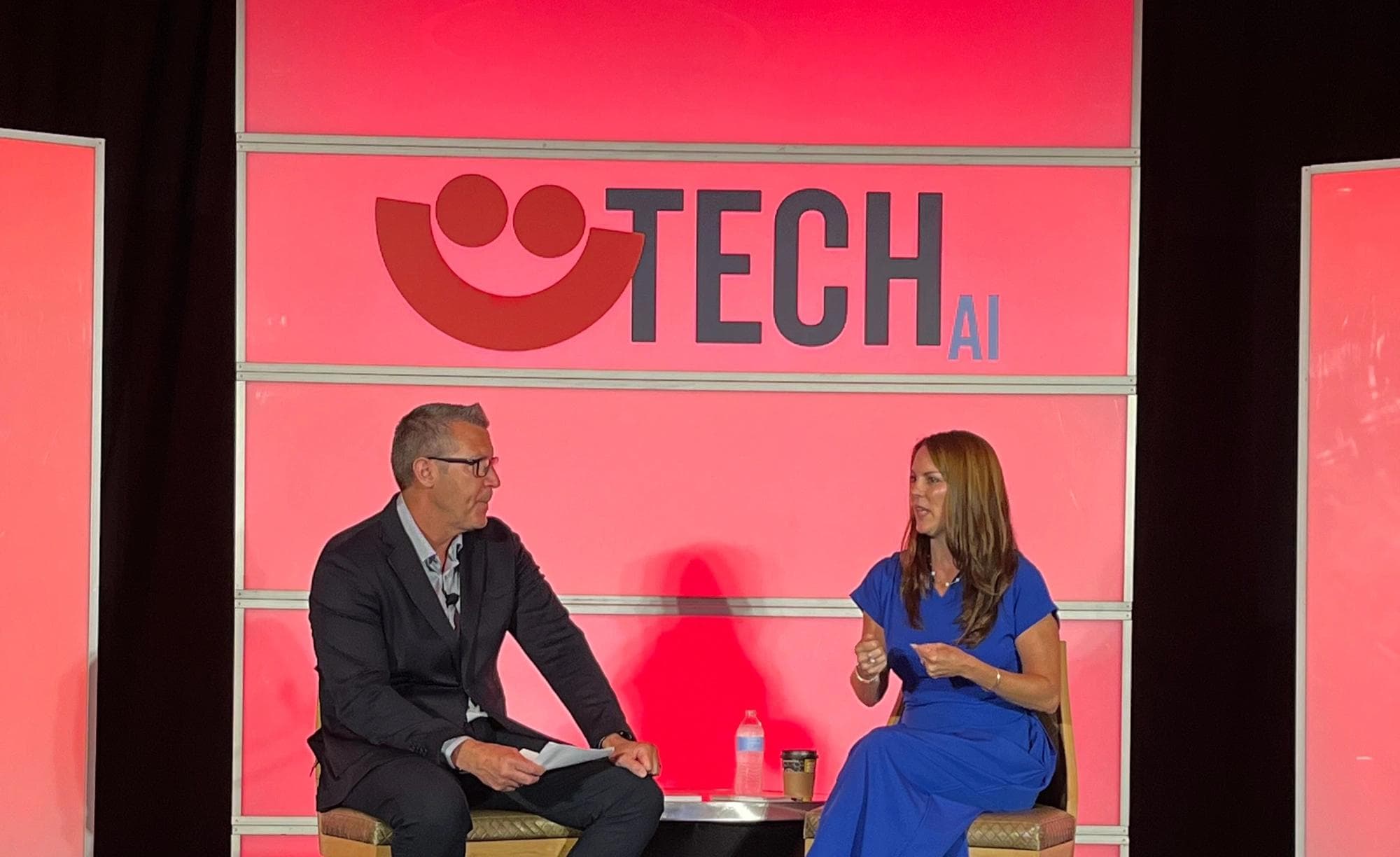
At the BMO-sponsored Summerfest TechAI 2026 in Milwaukee, Kristin Milchanowski, Chief AI and Quantum Officer, BMO Financial Group, and Founding Director of the BMO Institute for Applied Artificial Intelligence and Quantum, led a thought leadership session to help bring clarity to the situation. She discussed key topics from her new book, Return on Intelligence: A Strategic Enterprise Playbook for Scalable AI Agents.
Tim Dixon, Chief Digital and Information Officer of Regal Rexnord, a manufacturer of electric motors and power transmission components, hosted the fireside chat. The following is a summary of their conversation.
Calculating ROI
Measuring the ROI from AI seems straightforward: build agents to accomplish specific tasks, calculate the value it provides compared with doing the same tasks without the technology. For Milchanowski, however, the formula goes deeper.
Milchanowski said most businesses treat AI implementation as a series of projects, then try to calculate the ROI from each project. But the better approach is to treat AI as part of your organization’s infrastructure, and ROI measurement should be based on the effectiveness of that integration.
"The real trick is taking all of that insight from AI, embedding it into your organization as a layer of intelligence, and then you can operate in new ways,” she said. “It’s embedding the technology into your infrastructure so that you can leverage that intelligence repeatedly. I don't think that it's enough to say that you saved X number of human hours, or that a process that used to take three hours now takes 30 minutes. You have to take it all the way down to the operating leverage of your institution, because that is the metric that moves your return on tangible common equity.”
The human factor
While AI promises to be a transformative technology, the human element remains a key factor to successful implementation. As Milchanowski writes in her book, “Innovation without empathy is merely efficiency without trust.”
“The technology is the easy part; the leadership principles around it are the harder part,” she told the audience. “When I'm building tools for my colleagues or our clients, the best way to have it take hold is that they see themselves in it. When designing the technology, you have to design it from the start with the end user in mind. And when you have the end user in mind, it's understanding what they care most about and reflecting that in the design of your products.”
Milchanowski explained that BMO prioritizes the human-in-the-loop concept of integrating human intelligence into AI workflows. She also noted that in a world of AI agents, this will likely have downstream effects on the skills people will need to do their jobs.
"Human-in-the-loop is important because large language models are not as smart as we make them out to be,” she said. As employees gain access to AI agents, they effectively become managers of digital teammates. That means organizations should help employees develop skills in delegation, oversight and quality control to ensure AI-generated work is used effectively and responsibly.
The winners could be the ones who take the leap
At BMO, Milchanowski has focused on doing three things well:

Leverage AI to optimize daily capital position
Leverage AI to attract new clients
Use AI to enter new revenue streams.
Milchanowski noted that those principles can apply to almost any business sector. Ultimately, Milchanowski said, business leaders will have to take a similar leap of faith.
“Two types of people are going to win,” she said. “First are your experts, your AI natives, your digital natives. The other people who are going to win are the genuinely curious. So, even if you're not digitally native or if you haven't been part of a digitally native organization, we're finding that genuine curiosity will advance you as much as deep expertise. It's the people who aren't leaning in that are going to miss out.”