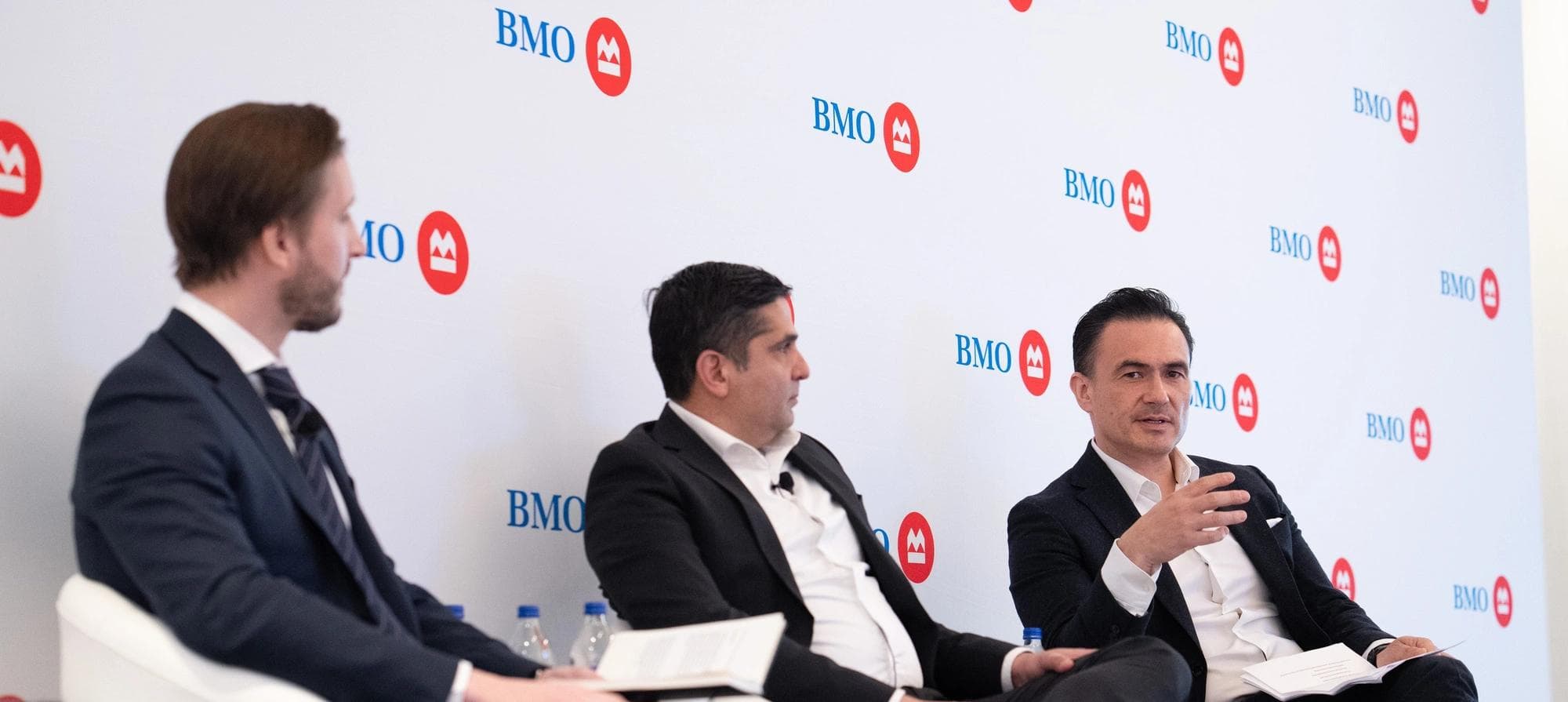
How companies adopt and pursue Artificial Intelligence tools varies by industry, size and geography. At the 2026 Annual BMO Government, Reserve and Asset Managers Conference in May, I spoke alongside peers about this topic, based on my experience navigating the transition to AI at BMO Capital Markets.
Listen to the full conversation: (26 minutes)
Markets Plus is live on all major channels, including Apple and Spotify.
Think about how to change behaviour
Start simple. You can start by giving access to tools such as Copilot, ChatGPT and others. Then, start adding quality data, so AI can really answer questions. That changes behaviour. It can enable people to focus on the most high-level tasks and think less about the manual processes that don’t add as much value.
In Capital Markets, there is now an opportunity to move to more complex workflows, enabling bankers to focus on client interaction rather than manual processes. That changes how teams interact with clients and helps to understand how to serve clients better.
Educate. Invest in AI education and make sure that education goes a long way. Create and distribute learning modules. Ask people to do at least one thing a day with AI and use AI as a learning tool. Encourage people to ask AI when they’re unsure how to do something.
What foundations matter the most?
The four foundations – data quality, product ownership, operating model and talent – are all very important. If one is missing, you cannot get anything done.
Data matters, but it’s not enough. You must have proper ownership to understand who owns the outcome.
To me, the most underestimated foundational pillar is the operating model. You can get to a prototype quickly, but you need to move out of the sandbox and scale with proper engineering teams. It’s not a technology problem, but a focus and execution problem.
Outsourcing
Never outsource anything related to your Intellectual Property or anything that makes your business unique. Everything else is fair game.
This space is changing very rapidly, so things like access to models, the ecosystem around it, are considered table stakes. You don’t have to spend time on it.
Spend that time identifying your priorities and overall business alignment – the key to what makes each of our businesses unique – and that is the piece I would never outsource.
Avoid the noise
There can be a lot of noise but there’s far more clarity today than two years ago – or even a few months ago. The conversations I’m having with vendors now are very different from those I had in the past. For example, even four months ago, nobody was talking about automating daily tasks in the same way as they are today.
Pilot to production
Getting to the pilot stage of a new program isn’t the main challenge. It’s thinking about scale. To scale, you need the right team of engineers behind the scenes who are going to take that application and bring it to fruition. Do not start building applications without considering scale.
Think about volume early on. If you can, bring in the right partners at the start. Teach your staff how to work with AI, scale and then own the solution.
Is it too late to start now?
The right time to start the AI journey was two years ago. That being said, the second-best time is today. Starting today is easier. The tools are better. The ecosystem has grown. You don’t have to build everything from scratch. You can move from laggard to fast follower more quickly. All of that is possible today. That requires investment – data infrastructure, technology governance and controls. If I were to start today, I would make sure to remain very focused and avoid distractions. Get going and focus on the right use cases.