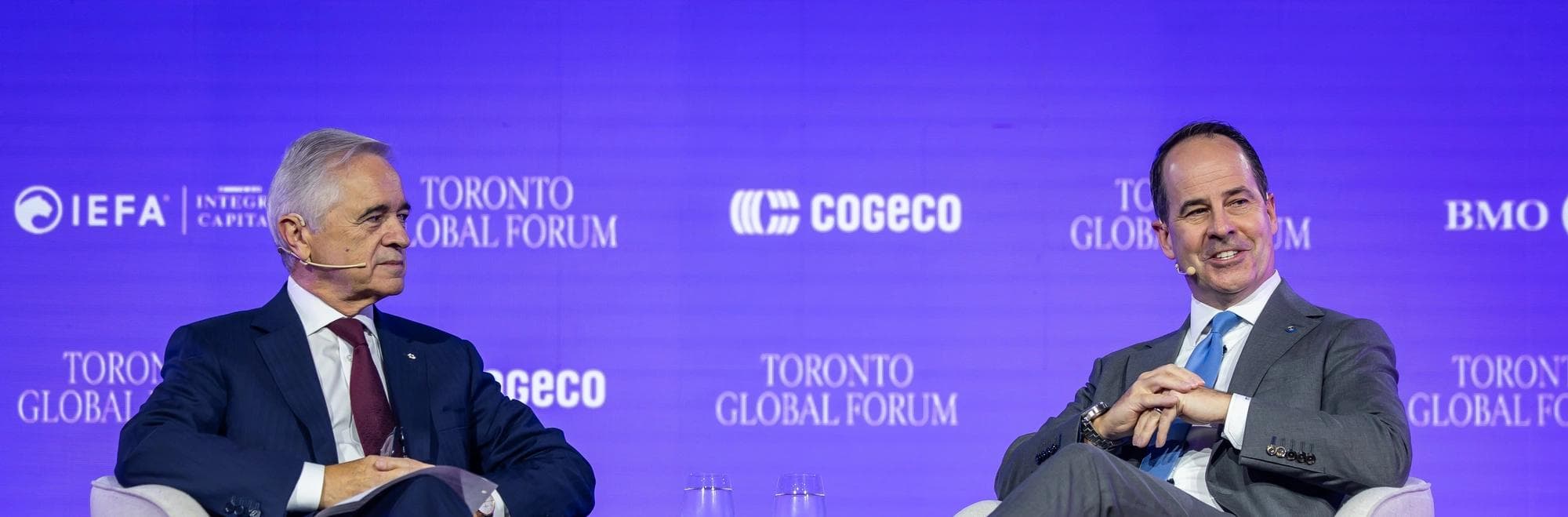


Canada has many of the ingredients needed to attract investment. The challenge is turning that potential into growth, as the world navigates geopolitical realignment and rapid technological change. That was the focus of the fireside chat “Canada and the World: Leading in an Age of Transformation”, featuring BMO CEO Darryl White and the Honourable Brian Tobin, Vice Chair of BMO, at the 20th annual Toronto Global Forum, organized by the International Economic Forum of the Americas (IEFA).
Listen to a Markets Plus episode based on insights from this conversation:
When White last took the stage a year ago, he said Canada's investment climate wasn’t all it could be, pointing to the country’s overall attitude towards allocators and its uncompetitive tax policies and regulatory environment. Much has changed since then. In the past few months, Canada has introduced a range of policy and tax measures aimed at attracting investment, committed significant resources to building a domestic defence industry and hosted an inaugural Canada Investment Summit to promote the country to global business leaders.
Tobin started the conversation by asking White for his assessment of how he sees Canada today.
Open for business
There's been a material change in Canada on many fronts, White acknowledged, describing the government's approach to business and investment as a near 180-degree shift from where it was a year ago. White pointed to the new accelerated capital cost allowance measures as perhaps the clearest example of the shift in tone and mindset.
Still, more work remains. “There’s been some progress,” he said. “I'll acknowledge that. But, at the same time, we need to get projects done faster. The capital that we talk about craves certainty.”
Nevertheless, he sees significant opportunities in Canada right now. Overall, the country continues to enjoy significant advantages, such as abundant resources, energy, critical minerals and talent, backed by a strong education system and a deep network of trade agreements.
Investing in defence
As Tobin noted, BMO’s recent commitment to mobilize up to $70 billion in new capital over the next decade into areas like energy infrastructure, electricity transmission, AI, critical minerals, broad-based distribution and transportation, and defence, is a strong endorsement of BMO’s belief in Canada.
Defence has been a particular focus for the company for a long time, White explained, noting that BMO has been the official bank of the Canadian Defence Community since 2008. Its commitment to the sector continues to grow with the recent announcement of Mike Bonner’s appointment as BMO’s Enterprise Chair, Canadian Defence Sector.
BMO’s growing focus on defence follows the federal government’s pledge to raise spending in the sector to 5% of GDP by 2035. Tobin pointed to the scale of Canada’s planned defence investments and the government’s aim to direct more opportunities toward Canadian companies.
“This is one of the most material opportunities we’ve seen in a very long time,” White said. Much of the focus will be on mobilizing middle-stage companies, some of which don’t even exist yet. He added that BMO will play a key role in helping develop those companies from early stages through maturity.
What’s next for Canada-U.S. relations
Despite the current trade tensions, White remains optimistic about the long-term Canada-U.S. relationship.
Although he expects the countries to retain an integrated supply chain and mutual economic dependence, it will take time.
Still, whatever deal the two countries work out, White said no one should assume the Canada-U.S. relationship will return to how it was two years ago. Some changes to the trade relationship may be permanent, he said, although most of the clients he speaks with have adapted well, through adjusting their supply chains.
He stressed that trade diversification shouldn’t diminish the importance of the Canada-U.S. relationship. Canada should continue to pursue its mutually beneficial relationship with its southern neighbor while also diversifying its trade.
“With the long view on it, I remain a deep optimist in the 'Advantage North America,’ as I called it before, recognizing that we’ve got to go through this period of transition,” he said.