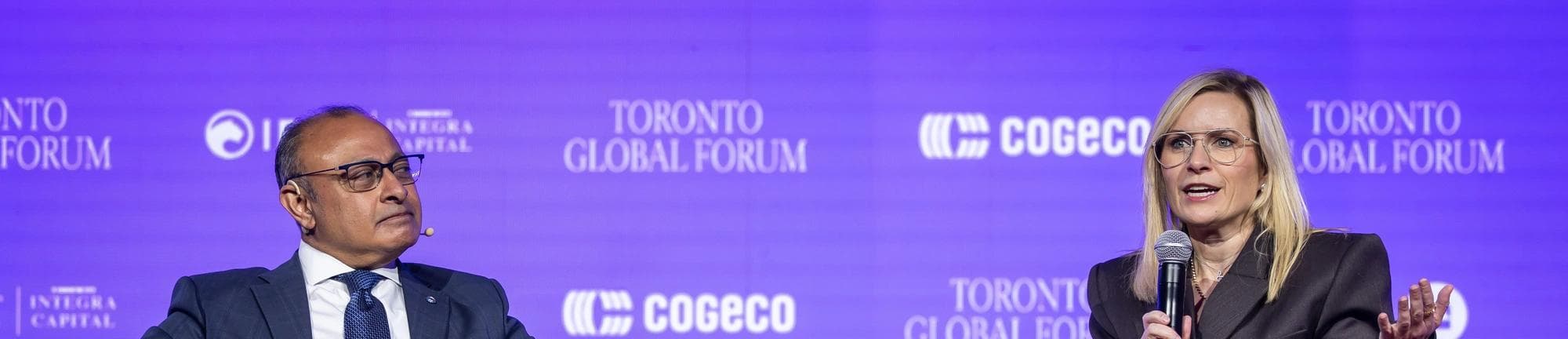


Canada and the U.S. could still return to trade discussions aimed at rebuilding trust between the two sides and forming a path to broader negotiations with Mexico. That was the main takeaway from a panel discussion focused on international trade during the 20th annual Toronto Global Forum, organized by the International Economic Forum of the Americas (IEFA). During the panel, “The Future of North American Trade Relations”, Nadim Hirji, Vice Chair, BMO Commercial Bank, North America, sat down with Kelly Ann Shaw, Partner at Akin and a former trade adviser to U.S. President Donald Trump.
Here are the highlights.
A trade dispute with wider costs
From Washington’s perspective, the tensions between the U.S. and Canada fall well short of last year’s confrontation with China, Kelly Ann Shaw said. While the tariffs have concentrated their effects in particular sectors, Shaw said most bilateral trade remains exempt. By her estimate, around 80% of goods crossing the border now move duty-free, down from 85% before the latest round of tariffs.
Although both countries are feeling pressure in the hardest-hit industries, she was optimistic.
One step at a time
The package that Canada and the U.S. discussed in August could still be the way for both sides to return to the table, Shaw said, with talks possibly resuming later this year or early next. In her assessment, Washington still sees that proposal as the best basis for an agreement.
Shaw described a potential package under which Canada would withdraw retaliatory tariffs on autos and alcohol and address U.S. concerns about dairy market access under the Canada-United States-Mexico Agreement (CUSMA), in exchange for lower U.S. sectoral tariffs. That relief would ease the pressure on affected businesses, although she cautioned those duties wouldn’t fall to zero.
Hirji asked whether progress in individual sectors could pave the way toward a comprehensive agreement. Shaw said the August talks focused on a limited, temporary package, with steel, aluminum and automotive largely in play and lumber – also a Canadian priority.
An agreement on that package would then open the door to broader negotiations under CUSMA, with Mexico joining Canada and the U.S. “It really is this narrow, targeted set of mutual concessions that sort of gets the parties to the table as a trust-building exercise,” she said.
Shaw said all three countries should work out rules of origin together once the broader talks begin. Rules of origin determine whether a product qualifies as originating within North America and is therefore eligible for preferential treatment under CUSMA.
Shaw said Canada and Mexico could negotiate separate bilaterial agreements with the U.S., which she called normal for a multiparty trade pact. In Shaw’s view, if the interim deal is completed by early 2027, broader negotiations could follow 12 to 18 months later.
Toward a stronger North America
Hirji acknowledged that negotiations require concessions but wondered whether shared interests could play a greater role in the talks. He said business owners in both countries see opportunities to strengthen North America’s competitiveness through cooperation in critical minerals, defence and agriculture.
Shaw agreed there was scope for that but said Washington’s priority is greater alignment with Canada and Mexico concerning tariffs and supply-chain exposure involving China.
Hirji closed by asking what decision a mid-sized Canadian CEO shouldn’t postpone despite the current economic uncertainty. Shaw’s view was that business leaders should continue investing across the continent, while being careful to assess overseas exposure to strategically sensitive supply chains.
Shaw remains optimistic, “the future, the economic future of North America, is bright,” she said.