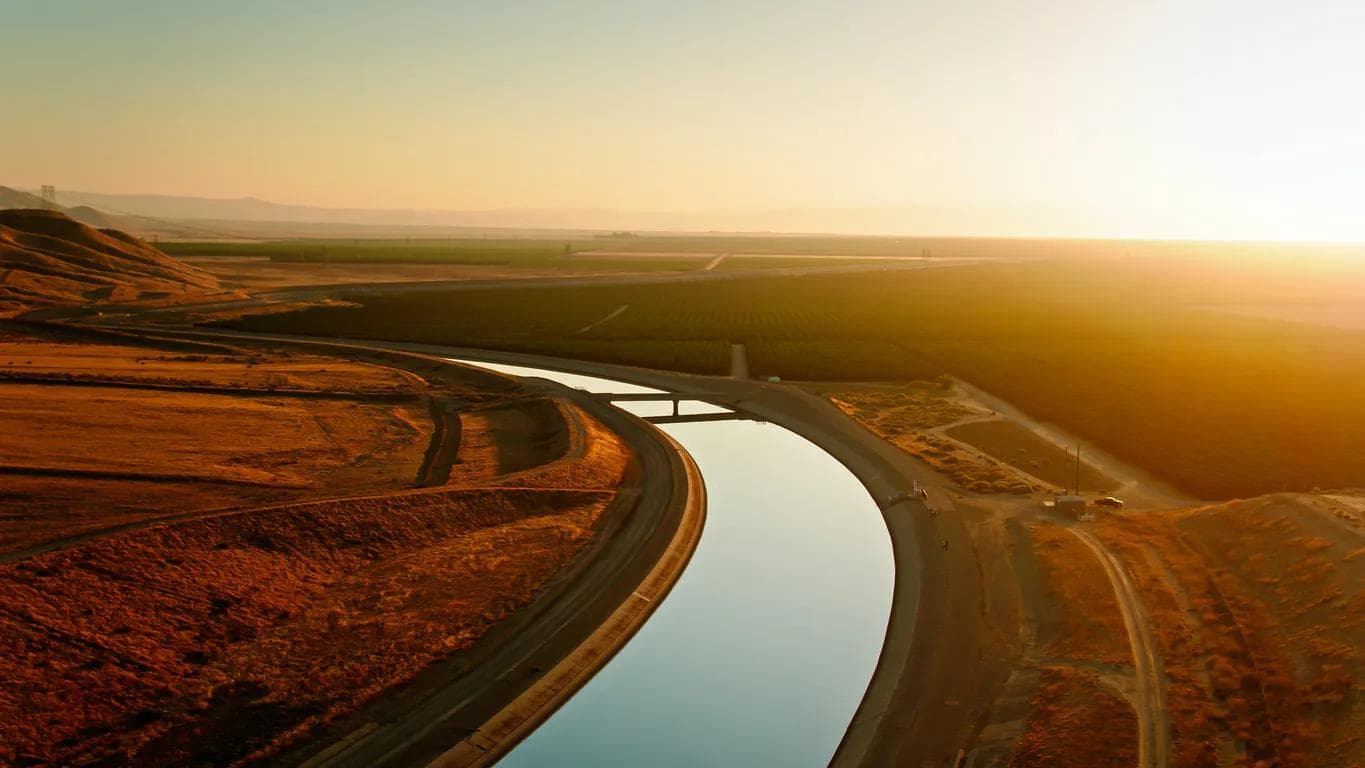


Water stress is an ever-present and intensifying issue affecting the economic landscape of the American West. This article examines the economic consequences of water scarcity in Arizona, California, and Colorado, three states that are central to U.S. agricultural production. Using county-level data and projections through 2030, the analysis shows how modest reductions in water availability—such as a 5% cut in irrigation—can trigger billions in lost agricultural revenue, wage declines across multiple sectors, and long-term risks to the regional economy.
Why Drought Is a Persistent Problem in the U.S. West
Periods of drought are a defining feature of the Western U.S. landscape. But a combination of climate change, overallocation of water resources, and declining seasonal snowpack is turning these droughts into chronic and increasingly challenging situations. Climate change is producing higher temperatures which are creating exceptionally severe droughts according to a 2024 study from UCLA, NOAA and CIRES. A report from the UCLA Center for Climate Science showed that snowpack in the Sierra Nevada—critical for water storage—is projected to decline by up to 65% by 2100. Streamflow in Colorado has already dropped by 5–30% compared to late-20th-century levels. The Colorado River, a lifeline for many western states, has seen severe reductions due to multi-year droughts. These trends are not anomalies—they are part of a long-term shift toward aridification, making drought a structural feature of the region’s climate and economy.
Scope and Methodology
The study focuses on three states with high agricultural stakes:

California: The largest agricultural economy in the U.S., contributing over $50 billion annually.
Colorado: A major producer with 30 million acres of farmland and $47 billion in agriculture-related economic activity.
Arizona: A top producer of vegetables, melons, and cotton, with $5.2 billion in agriculture sales.
The analysis combines water stress hazard data with economic indicators from the Census of Agriculture, USDA projections, NOAA drought data, and Bureau of Labor Statistics wage data. Three scenarios were modeled:
Losses from drought through 2030
Impact of a 5% reduction in irrigated water
Wage losses in agriculture and hospitality sectors due to severe drought
Findings
1. Drought-Driven Revenue Losses
Drought conditions are already having a significant economic impact. In California, five counties are each projected to lose over $100 million annually by 2030 due to drought, with Imperial County topping the list at $147 million. In Colorado, Saguache County could face $54 million in losses, while Navajo County in Arizona could lose $26 million.
The livestock sector is especially vulnerable, with Tulare County alone potentially facing nearly $60 million in losses. These figures underscore the disproportionate impact of drought on water-intensive agricultural sectors.
2. Impact of a 5% Reduction in Irrigation
While a 5% reduction in irrigation may seem modest, it is already occurring or being mandated in many areas:
Arizona: Active Management Areas (AMAs) are enforcing 5% cuts for high-water-use farms.
California: A 5% reduction in irrigated water is highly probable for California's agricultural sector. According to a study prepared for the California Department of Food and Agriculture, California’s irrigated farmland shrank by 752,000 acres, or nearly 10%, between 2019 and 2022
Colorado: Streamflow reductions of 5–30% are already documented.
Using 2030 projections, a 5% irrigation cut could result in:
$319 million in losses across California’s top three agriculture counties (Fresno, Tulare, Kern).
$41 million in losses for Weld County, Colorado.
$24 million in losses for Maricopa County, Arizona.
These figures do not account for indirect or induced economic effects, which could amplify the total impact.
3. Wage Losses Across Sectors
Severe droughts have economic consequences beyond agricultural production, particularly in wage impacts across multiple sectors. The agricultural sector could experience direct wage losses due to reduced crop yields, fallowed land, and lower employment levels. These losses could be compounded by the fact that agriculture often supports a network of related jobs in processing, transportation, and retail.
The hospitality and leisure sector could also be significantly affected. Drought can reduce tourism, recreational activities, and overall consumer spending in rural and semi-urban areas, leading to wage declines and job losses. In California alone, San Diego and Orange Counties could face combined annual wage losses of up to $873.5 million in the sector due to severe drought conditions.
Policy and Investment Implications
Farmers, business leaders, suppliers and the agriculture sector at large are already aware of the intensity of water stress, and there are many best practices in place today. Some organizations are actively implementing measures such as cover cropping, soil conservation techniques, climate resilience strategies, and sustainable land-use practices. These efforts are critical steps toward adaptation, but additional actions are needed to scale up impact and safeguard long-term productivity. Our analysis highlights the urgent need to accelerate efforts, particularly through adaptive strategies and policy interventions such as:
Water-efficient technologies: Drip irrigation, soil moisture sensors, and precision agriculture can reduce water use without sacrificing yield. For example, Nature Fresh Farms says it has experienced consistent yield growth due to AI models used in various parts of its operation, and has a closed-loop water system that recycles 99% of the water used.
Crop diversification: Transitioning to drought-resistant crops can mitigate risk.
Infrastructure investment: Modernizing water delivery systems and expanding groundwater recharge projects.
Financial instruments: Insurance products and drought hedging mechanisms for farmers and agribusinesses.
Public-private partnerships: Coordinated efforts between government agencies, investors, and agricultural stakeholders to build resilience.
Conclusion
Water stress is having a measurable impact on the economic outlook in the U.S. West. Without proactive measures, the regional risks to farms, jobs, and communities will grow. Policymakers, business leaders, and investors should consider acting to safeguard agricultural productivity, protect livelihoods, and ensure long-term economic resilience.
Helpful Links